
 Jui Trivedi

Why relying on a single offer can undermine your exit, and how a well-run process reveals not only price, but fit, structure, and the right future for the business
There is a particular kind of outreach many business owners are receiving right now.
A private equity firm calls. A strategic buyer sends a note. The message is usually some version of the same thing: they know the company, they respect what has been built, and they would welcome a conversation if the owner has ever considered selling.
The outreach is usually polished, often flattering, and easy to mistake for a reliable measure of market interest. There is nothing inherently wrong with taking the call. Where owners can misstep is in what happens next.
An unsolicited indication of interest can create the impression that the market has spoken. The owner begins to think: This is what my business is worth. But in the private markets, one buyer’s view is just that. It is shaped by that buyer’s strategy, timing, return requirements, and negotiating posture. It is not the market in any complete sense.
That difference matters more than many sellers realize at first.
Most owners sell a business once, perhaps twice, in a lifetime. Buyers do this repeatedly. They know the terrain. They know how value is presented at the outset, how terms evolve under scrutiny, and how leverage tends to shift when there is no real competition. Sellers, understandably, are often entering one of the most consequential financial events of their lives with far less market visibility than the party across the table.
That does not mean the buyer is doing anything improper. It means the seller should be careful about mistaking initial interest for a full expression of value.
There is still substantial private equity capital looking for quality companies, particularly businesses that fit a buyer’s strategic priorities. Bain’s 2026 report noted that buyout firms continued to hold roughly $1.3 trillion of dry powder even as deal activity improved. For owners of attractive private companies, that is an important backdrop: interest may be real, but so is the likelihood that more than one buyer could have an interest in the business.
Business owners understandably want valuation to produce a clear answer. In private company transactions, it rarely works that neatly.
The value of a business is shaped not only by its financial performance and underlying characteristics, but by who is looking at it and why. One buyer may see a solid company with steady earnings and some ordinary execution risk. Another may see a way to deepen customer relationships, expand geographically, fill a product gap, or accelerate a strategy already underway. A third may see a platform for further acquisitions.
That is why one business can attract meaningfully different valuations from different buyer types.
A strategic acquirer may be willing to pay more because the acquisition solves a problem they already have. A private equity platform may see a base from which to grow. An add-on buyer may see immediate opportunities to improve margins, centralize purchasing, or broaden an existing customer offering. Each is underwriting a different future. Naturally, each arrives at a different number.
The owner who negotiates with only one party is not necessarily seeing “the value” of the business. More often, they are seeing the value of the business to that particular buyer.
That is a narrower lens than many sellers appreciate.
The point becomes clearer when you look at real transactions.
In three recent competitive processes we ran, the spread between the low and high offers ranged from 55% to 76%. That is not a minor variation. It is the private market revealing itself.
Same company. Same financials. Same management team. Very different conclusions about value.
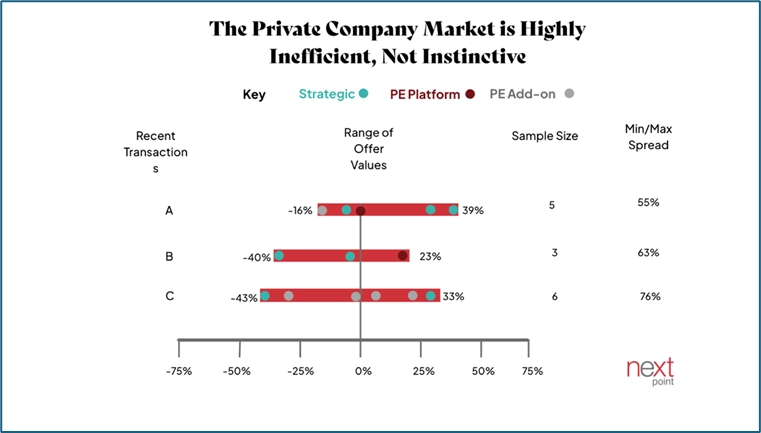
In one process, a buyer looked chiefly at current earnings and integration risk, while another was willing to pay more because the acquisition would strengthen customer relationships and accelerate a broader strategic plan already underway. In another, a financial buyer focused on cash flow and operational upside, while a strategic buyer placed a higher value on market position and service capability within an existing footprint. In a third, two offers appeared relatively close on headline value, but differed materially in contingencies, certainty at closing, and fit with the owner’s priorities.
That is why market value is discovered through a process. It does not emerge fully formed from a single conversation.
Once an owner moves forward with only one buyer, leverage begins to narrow. With no active competition, the buyer has more room to shape the pace, the terms, and the structure of the deal.
That can affect far more than price. It can influence diligence, contingencies, timing, escrows, and the portion of value that is actually paid at closing.
This is why some deals look less attractive as they progress, even when the opening number sounded strong. The headline price is only part of the story. What matters just as much is how much is paid at closing, how much is deferred or contingent, and what obligations remain with the seller after signing.
Market data reinforces the point. SRS Acquiom’s 2025 deal terms study, covering more than 2,200 private-target acquisitions, found that earnouts remain a meaningful feature of private deals and that purchase price adjustments and escrows are common. In other words, value in M&A is shaped not only by the number in the letter of intent, but by the structure beneath it.
That is not a reason to view buyers skeptically. It is simply a reason to approach a single-buyer discussion with clear eyes.
A well-run sale process is meant to do something very specific: test value, compare options, and give the seller a sound basis for decision-making.
The aim is not to show the business to as many buyers as possible. It is to identify the right buyer universe, prepare the company thoughtfully, and run a disciplined process that allows serious parties to evaluate the opportunity on a comparable basis.
That is how value is tested.
When multiple qualified buyers are engaged, the seller learns what a one-buyer discussion cannot reveal: who sees the strongest strategic fit, who is prepared to move with conviction, who is stretching on value, who is relying on contingencies, who wants the founder heavily tied to the business after closing, who understands the company best, and who is most likely to be the right steward of the next chapter.
Competition, when handled properly, does more than improve valuation. It improves judgment.
It allows an owner to compare not just price, but certainty, chemistry, timing, post-closing role, treatment of employees, and the future direction of the business.
There is another point worth making, especially for owners who care deeply about legacy.
The highest number is not automatically the best outcome.
The right buyer may be the one with the cleanest structure, the most realistic transition expectations, the strongest cultural fit, or the clearest strategic rationale for preserving and growing what the owner built. In some deals, the seller wants to remain involved. In others, the seller wants a clean break. Some buyers want a long transition. Others want very little. Some are committed to growth. Others are focused primarily on efficiencies.
These are not side issues. They are often central to whether a transaction feels successful after the closing dinner is over.
A competitive process is what gives an owner the ability to weigh those tradeoffs intelligently.
Without that process, the seller is often left evaluating one answer to a question that should have produced several.
When owners ask what their company is worth, what they are often really asking is something broader:
What is it worth to the market?
What is it worth to the right buyer?
What is it worth in a structure I can live with?
What is it worth if I care about employees, legacy, timing, and certainty, not just the top-line number?
Those are better questions. And they tend to produce better outcomes.
There is nothing wrong with taking the inbound call. It may be the beginning of a very good process. But it should be treated as the start of discovery, not the final word on value.
One buyer can tell you what the business may be worth to them.
Only a well-run market process can show you what the market is willing to pay.